
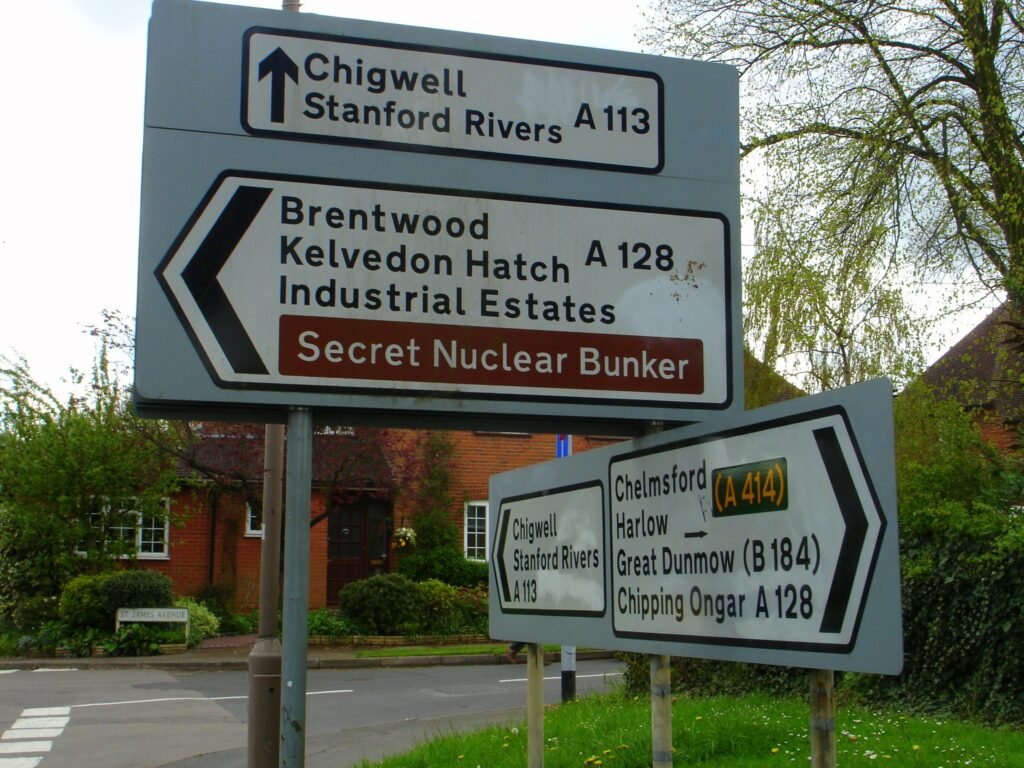
no longer a government secret this curious attraction presents life underground in an eerie and haphazard manner.
Room 205, a single bedroom with a communal bathroom, is the Prime Minister’s room. It contains a jumble of 1980s office furniture, a table set for tea, an umbrella, and a red despatch box. Tucked up in bed under a rough wool blanket is Margaret Thatcher.
I was visiting the secret nuclear bunker at Kelvedon Hatch in Essex. Part of a network of bunkers built between World War II and the Cold War, encased in concrete and a Faraday cage, it was designed to house 600 officials and civilians. Tasked with ensuring the survival of the population in the aftermath of a nuclear attack, it is here that Maggie might have been confined. “The Police Chief Superintendent would also have been entitled to a place here,” I’m told by Dave, a local man visiting with his daughter, “but his family would not.”
Two redundant missiles, green with algae, bordered the footpath. Behind them a brick cottage disguised the entrance to the shelter. I climbed the steps and went inside.
A tunnel sloped downhill. The concrete walls and ceiling were a dingy white, the gloom broken only by the occasional strip light. Dank air greeted me and, as I descended the tunnel, I glanced back at the last glimpse of daylight.
Set over three levels, this habitation system could provide protection for a few months to the chosen hundreds. Functional spaces included a sewage plant, engine room, sick-bay, telecommunications, administration, and plotting. Casting a uranium-like hue, illuminated Perspex maps dominated the plotting room; this is where nuclear detonations would be recorded. Public information films crackled on a loop and issued orders to those souls unlucky enough to be outside the bunker on how to ‘protect and survive’.
The tour route meandered through the seemingly endless space, and as I explored each floor the lack of curation became comical. Posed mannequins lurked in dark corners, wearing wonky glasses, ill-fitting wigs or radiation suits.
I giggled at the bandaged dummies in the makeshift operating room, and another visitor, Katie, told me that her Girl Guide unit had a sleepover here. The girls slept in the adjacent dormitory. “We hid the coffin and patients behind the medical screens,” she reassured me. I didn’t relish the idea of staying overnight so I followed the arrows towards the way out.
There are no glass display cabinets here. No interactive engagement. There are piles of unsorted artefacts. Whether the dilapidation and lack of ambition is intentional or not, the place verges on being so bad it’s good. It is bleak. It is captivating. In places it is as if those who worked here have momentarily stepped away from their stations. But the jaded approach to the exhibits and mannequins seems to lighten the futile mood of the realities of nuclear war.
As I exited back out to the countryside, past the gift shop and celebrity wall of fame, the musty air clung to my skin and clothes and remained in my nostrils until I was home.